Weapon proficiency is a crucial skill in self-defense situations.
Knowing how to use a weapon properly can serve as an equalizer when you are overpowered or outnumbered.
What is Escrima?
The Filipino Martial Art of Escrima relies on motion and angles of attack. All motion with a stick can translate to the use of other weapons and to empty-hand motion. Sinawali (double-stick) practice trains the left side and the right side equally, and builds something every Martial Artist should have: body symmetry. Training double-stick develops our coordination, rhythm, and sense of distance.
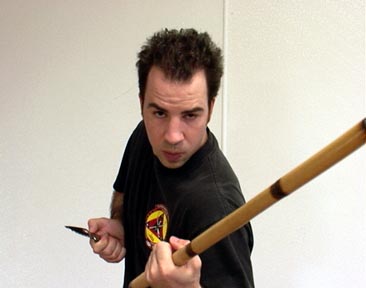
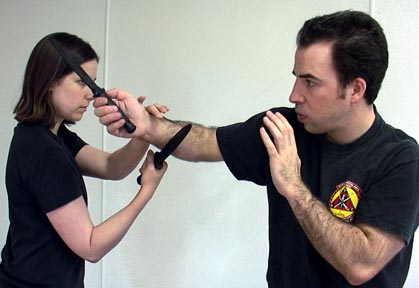
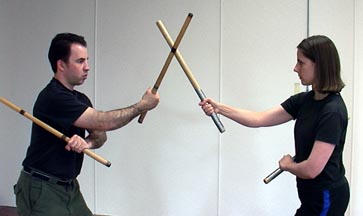
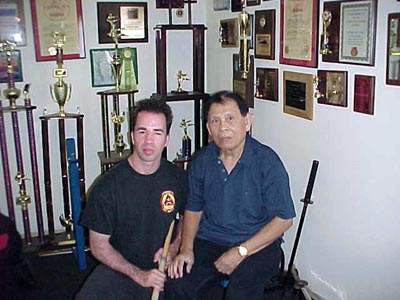
UMA instructor Rob Eis is a 1st Degree Black Belt in Doce Pares Eskrima under Grand Master Ciriaco “Cacoy” Cañete. Cañete was a 12th-degree black belt and the longest-surviving, highest ranking member of the famed Doce Pares Eskrima Club founded in 1932. He passed away in 2016.
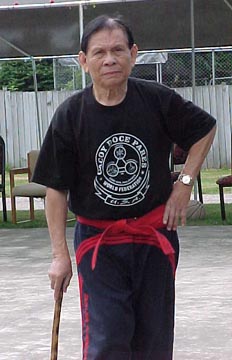
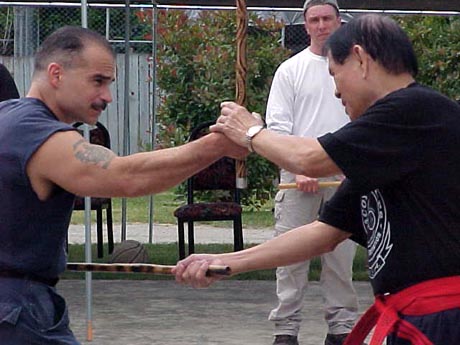

In the UMA weapons program you will develop preservation skills under the following four circumstances:
- Self-defense when you are weaponless against a knife attacker
- Self-defense utilizing a knife against a knife attacker
- Self-defense using a stick against a knife attacker
- Self-defense with a knife or stick against an overpowering assailant
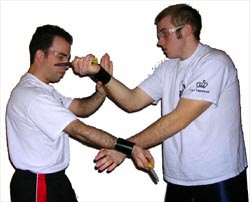
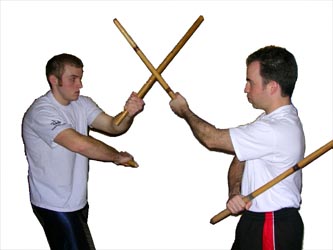
We provide the following training equipment for Escrima lessons:
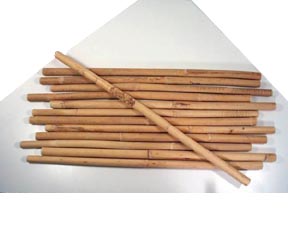
- Rattan escrima sticks
- Foam sticks
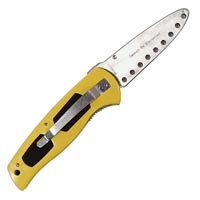
- Dull safety-training knives
- Protective eye-wear
When class is focused on stick sparring, students must use their own protective equipment:
- One 28-inch “ActionFlex” escrima stick
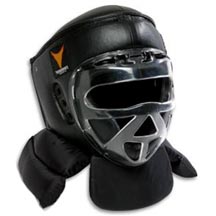
- Headgear with a face-mask (cage only: no plexi-glass stlye)
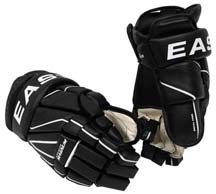
- Protective gloves that cover the fingers (suggested ice-hockey style)

Students must have their own gear to spar: ask the instructor for details. The weapons class is only on Wednesday nights. Therefore, there are only 4 or 5 classes per month. As such, lessons are introduced incrementally over 1-month periods, each week building on the last. NOTE: if you are joining later in the month, class pace will be more accelerated compared to the beginning of the month. We provide Escrima Sticks & Training Knives for beginners to borrow. Our sticks are extremely durable, plain rattan imported from the Philippines. They are 28″ long, 7/8″ diameter w/ natural skin & beveled ends.
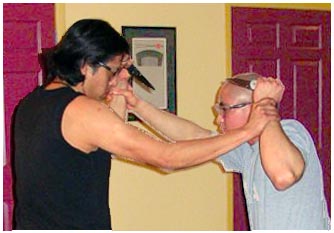
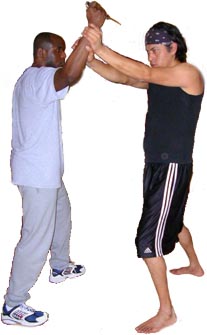
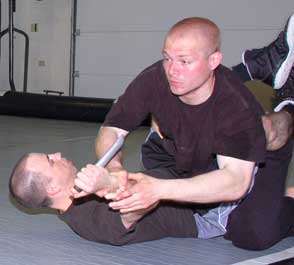
UMA’s weapons training curriculum will cover the following self-defense scenarios:
- Empty hand vs. Knife
- Stick vs. Stick
- Stick vs. Knife
- Knife vs. Knife
- Knife vs. Weaponless Assailant
- Stick vs. Weaponless Assailant
Why emphasize knife training?
At Unbridled Martial Arts it is crucial for students to educate themselves and train for the reality of a knife attack. Knives are readily available, easy to acquire regardless of age, and they are easy to carry and conceal. Because of these truths, the UMA program addresses the issues of how to use and deal with knives.
The UMA knife training curriculum teaches five tactical steps to follow, in this order, when unarmed and threatened with a knife.
1) Escape whenever possible.
2) When an edged weapon comes to you, minimize vulnerable areas while clearing away the intended target.
3) Control the assailant’s weapon.
4) Counter attack to neutralize the attacker.
5) Only after countering do you attempt to disarm.
What is the best strategy for dealing with a knife attack?
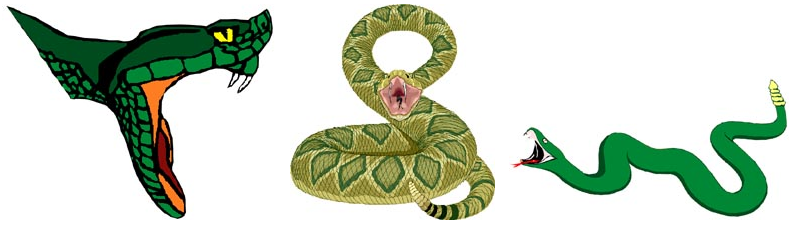
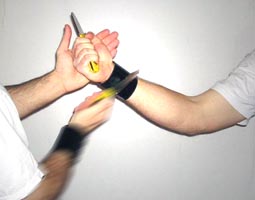
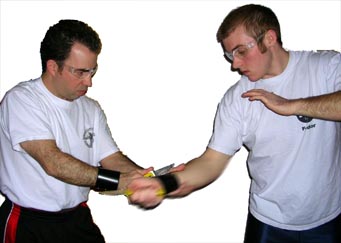
In combat with or against a knife, a primary goal of ours is to inflict injury to the weapon hand or striking hand of an attacker. This idea of smashing or cutting the assailant’s hand as he delivers a strike is a concept from Escrima called “de-fanging the snake.” In other words, once you remove the poisonous fangs of a snake, it is no longer a threat. The same holds true when you injure or disarm an attacker’s weapon or means of delivering the weapon. For knife training purposes, this method of “de-fanging the snake” entails cutting across the inside wrist or forearm.
Recommended Reading:
The following information will assist you in consulting local laws in Washington State about owning or carrying a tactical folder.
All of our permanent laws in Washington State are compiled in the Revised Code of Washington (RCW). These Session Laws are arranged by topic with amendments added and repealed laws removed.
Under the RCW Dangerous Weapons section, laws regarding knives fall under these headings:
Deadly Weapons, Weapons Carrying or Handling, Possession of a Weapon in a Prohibited Area.
RCW 9.41.250, RCW 9.41.260, RCW 9.41.270.
Note, the definition of a “Dangerous knife” means any fixed-blade knife and any other knife having a blade more than three and one-half inches (3 1/2″) in length. For details, see the Protocol for Measuring Knife Blade Length.
Additional Resources:
Washington State Knife Laws
Knife Laws for Other States
For an in-depth understanding of the laws regarding knives, a non-profit organization called The American Knife and Tool Institute has assembled a short guide describing basic knife laws and violation consequences: Understanding the Laws regarding Knives.
RECOGNIZE: The use of a knife in self-defense must be morally and legally justified. Therefore, it should be used only when threatened with deadly force. In doing so, the user assumes all liability for subsequent actions and will have to justify the severity of their response in accordance with the level of threat presented.