Unbridled Martial Arts in the News
Below you will find references to UMA in the local news and other media outlets.
The Western Front
Self-Defense on YouTube and TikTok is harder than it looks: Professionals’ opinions on self-defense and the realities of dangerous situations
March 23, 2022
UMA Black Belt Noel Abbott interviewed by The Front.
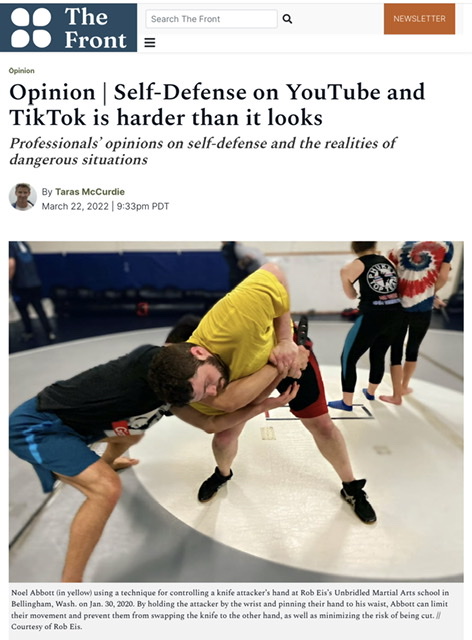 Excerpt from the article…
Noel Abbott holds a first degree black belt and has been training regularly for 11 years in self-defense and mixed martial arts at Eis’s school in Bellingham, Unbridled Martial Arts.
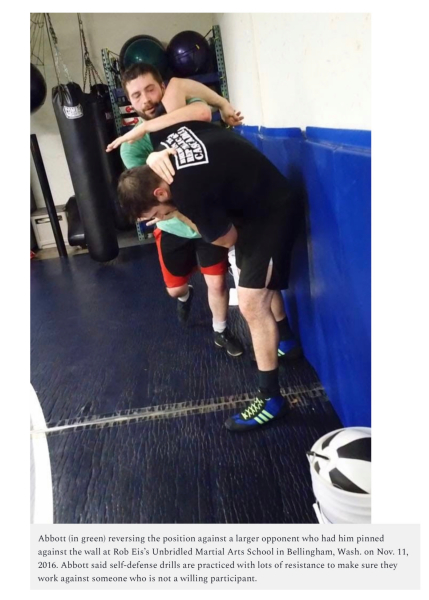 In all the demonstrations Brown shows, all the shooter would have to do is take one step back and pull the trigger, Abbott said in an email. There were no follow-up techniques, and the demos seemed to end after one strike against the attacker, he said.
“Is that really going to be enough to end the fight against someone who is determined to kill me? Definitely not,” Abbott said.
He said the videos seem like they are purely intended to get views and clicks, and he hopes that people are not taking them for anything other than entertainment.
“The idea that you could learn any kind of useful self-defense skills just by watching a video is stupid,” Abbott said. “To build competence with any technique, it takes repetition and practice against someone who is actively resisting you.”
The Western Front
In the ring around Whatcom County: A ringside look at mixed martial arts and self-defense opportunities at Western Washington University and in the area
March 10, 2022
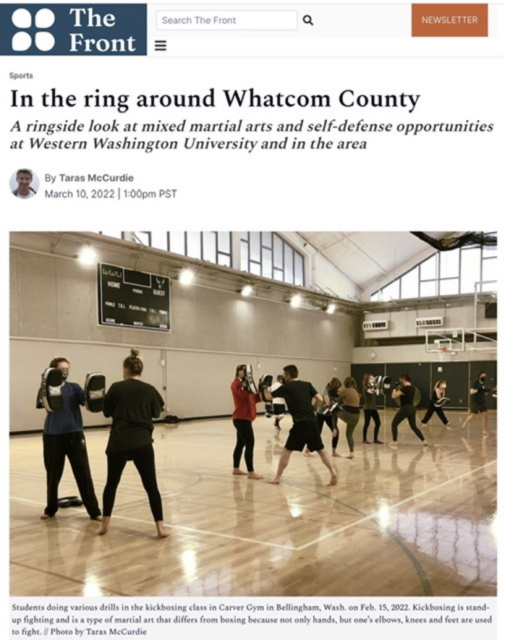 Have you wanted to get fit but haven’t found the motivation to run on a treadmill or bundle up and go outside? Or worse, have you or someone you knew ever faced a dangerous altercation that could have resulted in severe harm or death, and neither of you had an idea how to fight back for protection?
Good news! There are opportunities on campus and around Bellingham to learn the necessary skills to protect yourself and others if a dangerous situation were to arise.
Rob Eis is a non-tenure track instructor with about 10 years of experience working at Western. He’s been doing martial arts for 40 years and has also been running a mixed martial arts school for 18 years called Unbridled Martial Arts, located in Bellingham, Eis said in an email.
Eis began karate training in Bellingham in 1981. He said the town only offered karate, kung fu and taekwondo classes while having wrestling at the school. By the time he was a high school freshman, he was one of 12 athletes in the nation who competed internationally for the junior United States national team.
In his mid-twenties, Eis started branching out. He said in the sport arena, karate isn’t continuous fighting like boxing, but rather an intense game of tag for points.
“I knew that a street assailant would not fight under any rules I’d been taught, so I trained in judo, western boxing, submission fighting, grappling, escrima, jiujitsu and muay thai,” Eis said. “Knowing I can fight with something innocuous like a ballpoint pen, a screwdriver, a pair of scissors, a rolled up magazine, a flashlight, or in a last resort situation, shatter a knee with a stomp or kick [or] eye gouge someone without them being able to stop me. I have taken a majority of the fight out of them.”
Before coming to Western, Eis also worked as a juvenile corrections officer for Whatcom County and earned his certification as a Level II Defensive Tactics instructor.
Each quarter, he teaches three beginning-level classes at Western:
- Martial Arts
- Self-Defense
- Kickboxing
Eis said that martial arts incorporates four different arts: kickboxing, jiujitsu, escrima and defensive tactics that addresses stand-up fighting, ground fighting and fighting with an impact or edged weapon.
He explained that self-defense is focused on detecting and avoiding, defusing if unavoidable and as a last resort, physically defending oneself. It incorporates moves not allowed in competition, such as strikes to the groin, knees, throat, eye gouging and biting, along with defending common attacks, baseball bat attacks, using a knife for self-protection and understanding the primary laws of self-defense.
Kickboxing is more sport-oriented and centers on fitness and competitive fighting while standing up, he added.
Fourth-year Alex DeChenne is currently in the mixed martial arts class.
He said he’s really enjoyed learning how to fight and defend himself while also having Eis as the instructor.
Third-year Mich Ohata is also in the same class.
“I joined because I enjoy martial arts,” Ohata said.
He said he likes the enthusiasm the instructors bring and their guidance of the motions in the art.
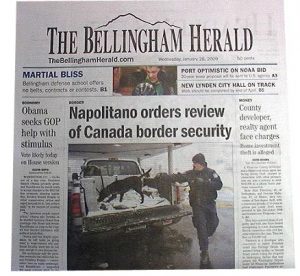
Bellingham Herald Community Spotlight: Martial arts school takes different approach
MICHELLE NOLAN, January 28, 2009
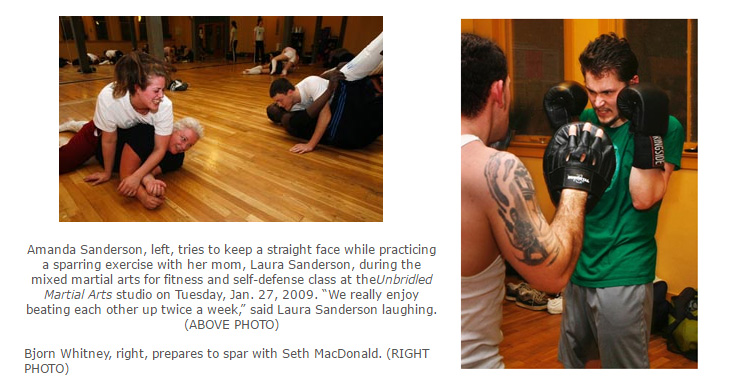
Rob Eis once said, “Bellingham needs another martial arts school like it needs another Starbucks.” So in 2003 he founded Unbridled Martial Arts – a school that’s a little bit different. “No contracts, no belts, no kids,” Eis said. “We have the only non-commercial martial arts studio in the county.”
Unbridled’s Web site says that by being non-commercial, the curriculum is not pre-packaged or developed by any outside group. Eis said he does not purchase other companies’ programs and spoon-feed them to his students, and he doesn’t utilize any revenue-generating schemes or require students to pay for mandatory tests or costly martial arts competitions.
“We’re not a place for anyone who wants to brag about getting a black belt,” Eis said. “There’s no talk of belts in our studio. We’re not part of any commercial organization. I don’t do gimmicks, special rates, or trials. It’s $30 a month, three nights a week.” Eis said that money goes to sustaining the school’s operation, not fattening his wallet.
Eis, a 38-year-old graduate of Bellingham High School with 28 years of martial arts experience, is a corrections officer with Whatcom County Juvenile Detention. In his youth he earned black belts, including numerous state and regional titles highlighted by competition in the Pan American Games, and he still doesn’t discourage others who seek that path. “We actually list all the local martial arts studios on our Web site,” he said. “We want people who come to our studio to feel it’s the right place for them, and we want to make sure they’re comfortable.”
Unbridled’s members must be at least 16.
Four of Unbridled’s members – Bellingham residents Felicia Molano, Seth MacDonald, Manis Pierre and Alec Kirk – said Eis’ studio provides a feeling of camaraderie and a special fellowship in the spirit of martial arts. “It’s kind of like a family in some ways,” Pierre said. “It’s a unit, a body, an organized group of people with similar ambitions. I like to know how to defend myself.”
The athletic ability of Eis’ pupils varies greatly, from those who are non-athletes to former high school standouts. “I love (mixed martial arts) and I’ve always wanted to participate,” said MacDonald, who was a former football player at Bellingham High School. “I was hesitant at first to come in about two years ago, because I don’t like feeling stupid. But I found that Rob’s a great teacher. He puts things in layman’s terms, and he has real patience. He doesn’t make anyone feel small. I never have a bad day in his MMA classes.”
Eis, instructs in a variety of combative systems, including Western Judo [typo: Western Boxing], Muay Thai, kickboxing, street self-defense, Shamrock Submission Fighting, grappling, judo, Brazilian Jujitsu and Escrima (Filipino stick and knife fighting).
Molano, who felt like a non-athlete before entering the program, said her mixed martial arts instruction helped her cope with cancer. “I’ve been cancer-free for one year,” she said. “I’ve been with Unbridled for three years, and MMA has helped me become more aware of my body.” Eis said Molano has been “a rock of stability” in his program and a great example for people who weren’t high school or college athletes.
Many of Unbridled’s students feel that Eis’ teach style should be an example for other “commercialized” studios. “Rob is never demeaning and never talks down to anyone,” Pierre said. “I like the discipline and consistency here. I like things I can depend on, and Rob is totally dependable. The snow never keeps him away from our studio.”
Additional Photos Posted to the Newspaper’s Website
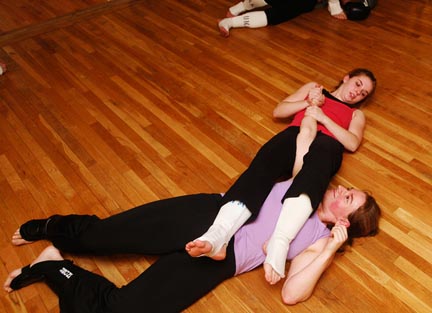
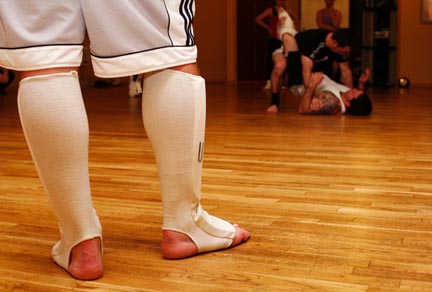
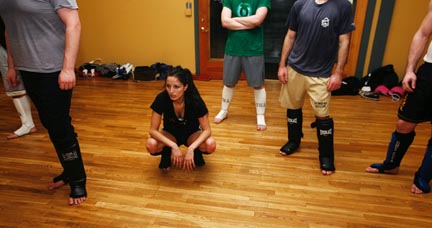
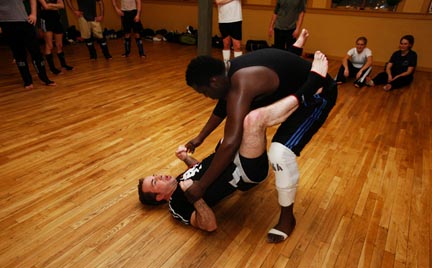
All photos taken by Bellingham Herald photographer Katie Barnes.
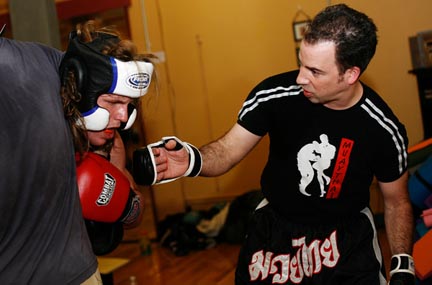
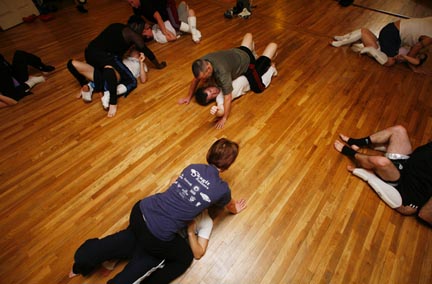
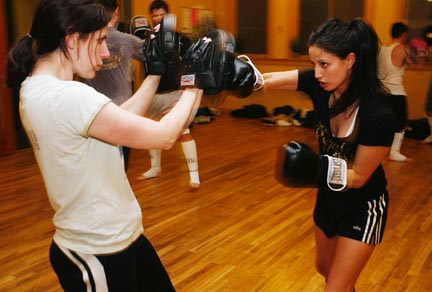
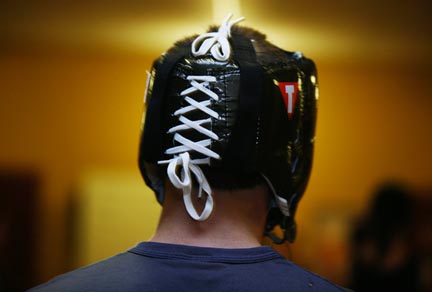
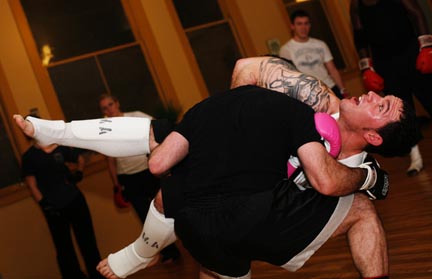
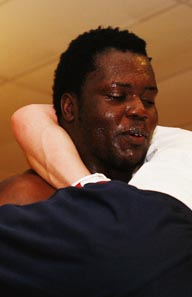
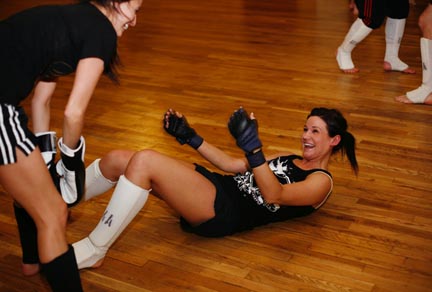
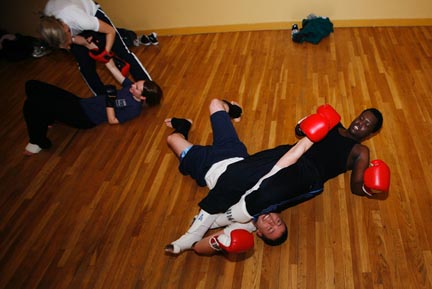
Frank Shamrock promotes Unbridled Martial Arts in his book, “Mixed Martial Arts for Dummies”
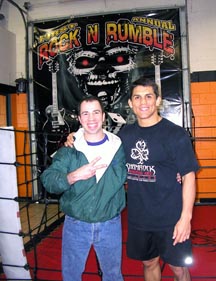
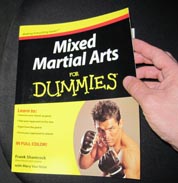

Now go out there and buy a copy!
VOLUNTEER SPOTLIGHT from the Max Higbee Recreation Center’s Spring 2011 Newsletter Publication

Rob Eis has provided adaptive karate classes at Max Higbee Center every month since 2003. Read about his experience.
My school’s martial arts program is centered around giving back to the community and I thought this would be a great way to present martial arts to a vital part of the community. During the more than 20 years that I had been doing martial arts in Whatcom County, I had not seen adults with developmental disabilities invited to, or exposed to, the fun, health-conscious side of martial arts practice. As soon as I stepped into the center, I saw many familiar faces: guys I’d graduated from high school with many years ago and others that lived in my childhood neighborhood. The beauty of this reunion was that although we had all grown older, their optimism and zest for life had not diminished one iota.
Over the years, the group that practices with me sometimes changes, however, the enthusiasm and active participation never falters. In my line of work as a corrections officer I continually have to motivate the unwilling and unappreciative. In contrast, at Max Higbee, I see people achieving far more with what they have, compared to others fully capable. They’ve shown me that there are no such things as limitations. Overall, it doesn’t matter how high someone can kick. My endeavor for the group is that doing martial arts simply becomes a tool used to strengthen and lengthen everyone’s mental focus by the sheer act of putting their minds into their bodies. The underlying outcome that grows from each class is the noticeable improvement in each student’s reflexes and ability to remember techniques. The crowd at the Max Higbee Center is an inspiration to me because no one ever makes excuses or says, “I can’t.”
Klipsun Magazine, Winter 2012: The Breaking Point
(an independent student publication at WWU)

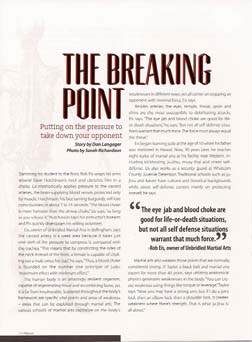
Story by Dan Langager, Article Photos by Sarah Richardson
Here is a portion of the article:
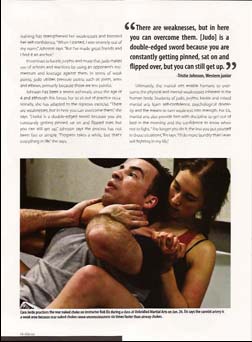
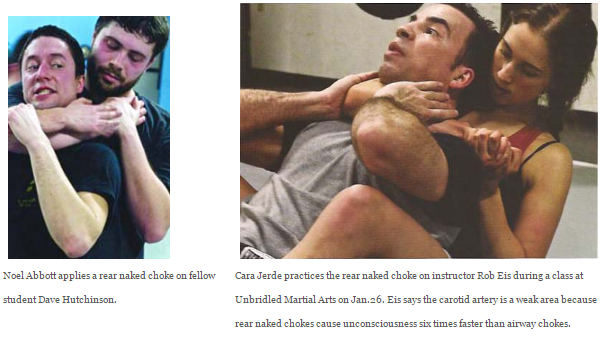
Slamming his student to the floor, Rob Eis wraps his arms around Dave Hutchinson’s neck and clenches him in a choke. Eis methodically applies pressure to the carotid arteries, the brain-supplying blood vessels protected only by muscle. Hutchinson, his face turning burgundy, will lose consciousness in about 7 to 14 seconds. “The blood choke is more humane than the airway choke,” Eis says, “as long as you release it.” Hutchinson taps his instructor’s forearm and Eis quickly disengages his willing volunteer.
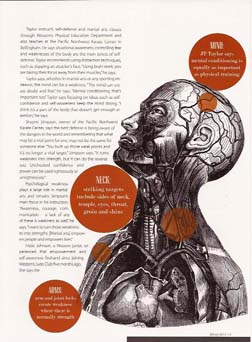
Eis, owner of Unbridled Martial Arts in Bellingham, says the carotid artery is a weak area because it takes just one-sixth of the pressure to compress it, compared with the trachea.
“This means that by constricting the sides of the neck instead of the front, a female is capable of choking out a male twice her size,” he says. “Thus, a blood choke is founded on the number one principle of judo: ‘maximum effect with minimum effort.’”
Learn more about UMA: